
The topics / Styles and weapons
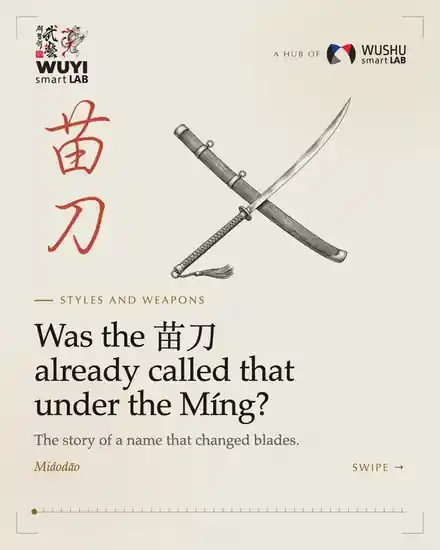
The name Miáodāo 苗刀
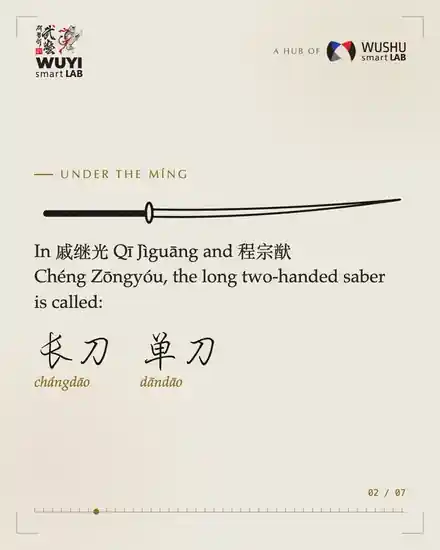
Under the Ming, in Qī Jìguāng 戚继光 and Chéng Zōngyóu 程宗猷, the long two-handed saber is called 长刀 chángdāo, or 单刀 dāndāo.
Video on June 19, 2027
An excerpt from the carousel
The first pages. The rest comes out on our social media.
References
The sources for this topic, in APA 7 format.
- Qī, J. (2001a). Jìxiào xīnshū 纪效新书 (shíbā juàn běn 十八卷本) [New treatise on military efficiency, eighteen-juàn recension] (W. Cáo & Y. Lǚ, Eds.). Zhonghua shuju. (Original work published ca. 1562)
- Chéng, Z. (1621). Gēngyú shèngjì 耕餘剩技 [Techniques left over from the leisure of farming] [Facsimile, shelfmark NCL-05752]. National Central Library, Taipei.
- Hé, L. (n.d.). Zhènjì 陣紀 [Record of formations and training] (Vols. 1-2) [Facsimile, shelfmark NLC892-1191]. National Library of China, Beijing. (Original work published ca. 1589)
- Mǎ, M. (2000). Shuō jiàn cóng gǎo 说剑丛稿 [Essays on the sword]. Lanzhou daxue chubanshe.
- Guō, R. (1986). Miáodāo 苗刀 [The Miao saber]. Renmin tiyu chubanshe.
All topicsBack to the listFind a club (in French)
Practice
The Wuyi program is taught in Angers, Cholet and Nantes, to teenagers and adults.